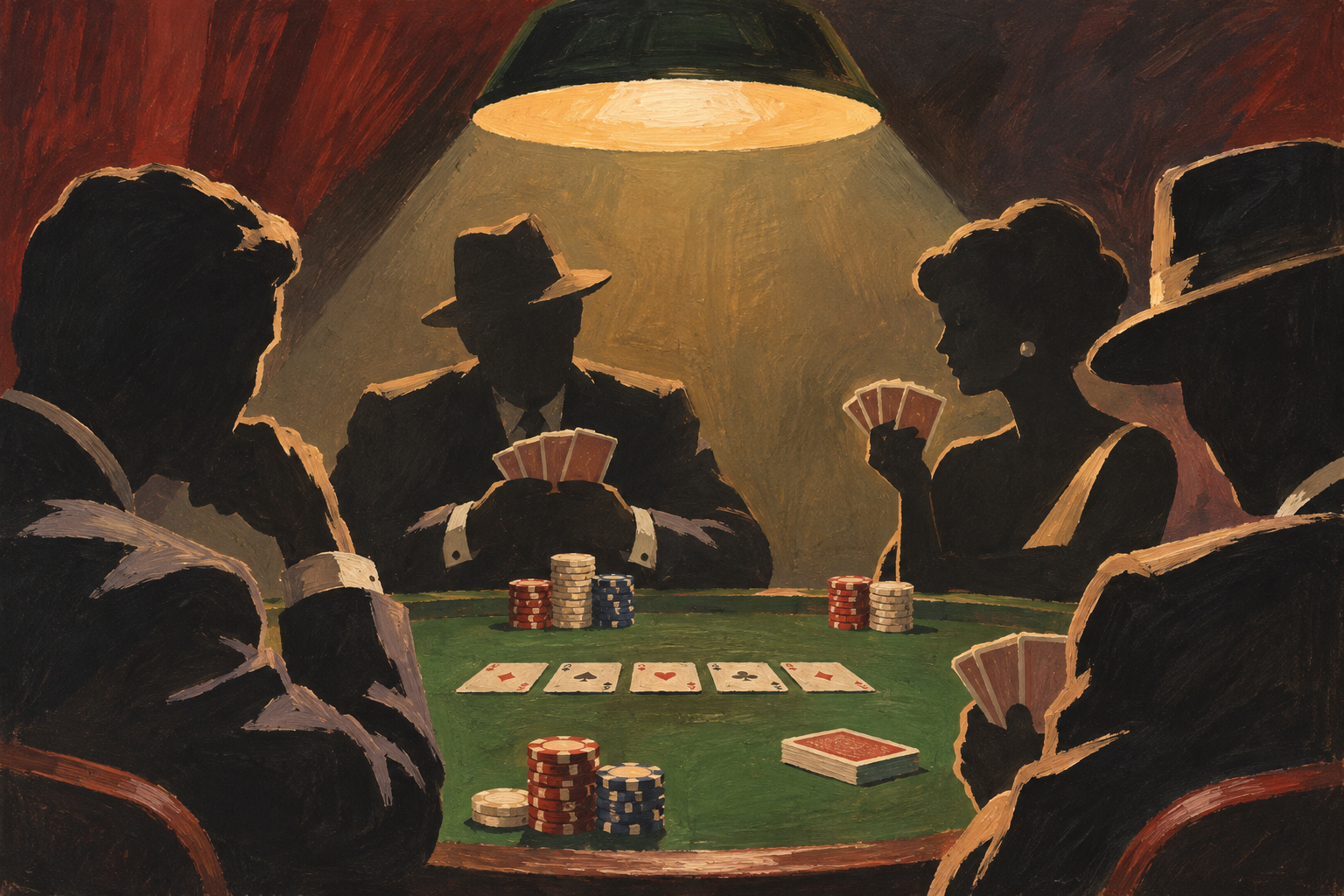
In The Cincinnati Kid, a poker table becomes a place where reputation can be won, protected or punctured. Norman Jewison’s 1965 film casts Steve McQueen as the ambitious Kid and Edward G. Robinson as Lancey Howard, the established player he wants to challenge. The confrontation offers more than a contest over money: it turns the desire to be recognised into a dramatic stake of its own.
The American Film Institute’s catalogue records a 113-minute American drama, adapted from Richard Jessup’s novel, with a screenplay credited to Ring Lardner Jr and Terry Southern. The supporting cast includes Ann-Margret, Karl Malden, Tuesday Weld and Joan Blondell. Those credits place the film within a substantial Hollywood production, but the central proposition remains compact enough to explain at a table: a challenger meets a man whose authority has already been established.
Why poker works on screen
Cards provide cinema with a useful contradiction. The rules give an encounter structure, yet the meaning of a hand depends on information other people cannot see. A player must make decisions in public while keeping intentions private. A film can build tension from that imbalance without requiring its audience to know every technical detail of the game.
The Kid’s ambition makes the situation legible even to a viewer who has never played five-card stud. He wants to prove himself against Howard, known as the Man. In the AFI festival description, the contrast is between a confident challenger and a veteran backed by decades of experience. The question is not simply who holds the stronger cards, but what it means for each man to sit down against the other.
That distinction is why the film is worth considering as a story about risk as well as gambling. A bet is a decision taken before the outcome is known; a challenge to an established rival is also a bet on one’s own judgement. Confidence can be a resource, but it can also make a player vulnerable to the need to demonstrate it.
People around the table
The credits suggest a world larger than the central duel. Karl Malden plays Shooter, Joan Blondell is Lady Fingers, Ann-Margret plays Melba and Tuesday Weld plays Christian. A gambling story gains texture from such surrounding characters because a contest does not happen in a social vacuum: loyalties, pressures and relationships can alter the meaning of what looks like a private test of skill.
McQueen and Robinson also bring a striking generational contrast to the premise. The names themselves frame a meeting between a rising figure and an established one, while the character names, Kid and Man, make that contrast explicit. The title gives the younger player the headline, but the older rival is essential to defining the achievement he seeks.
A classic with a clear hook
The AFI catalogue traces the production to the purchase of Jessup’s screen rights in 1964 and records a New Orleans premiere in October 1965. Jewison directs, Philip H. Lathrop is credited with cinematography, and Hal Ashby with editing. These details offer useful points of entry for a viewer interested in how a literary gambling story became a studio film, without requiring claims about where the film can currently be streamed.
My editorial recommendation is for the premise and its dramatic architecture: the contest gives a complicated subject a clean shape, and the cast gives the confrontation a compelling historical context. It is not a claim that I attended a screening. For anyone curious about the way cinema turns chance, skill and status into a shared spectacle, The Cincinnati Kid is a strong starting point.