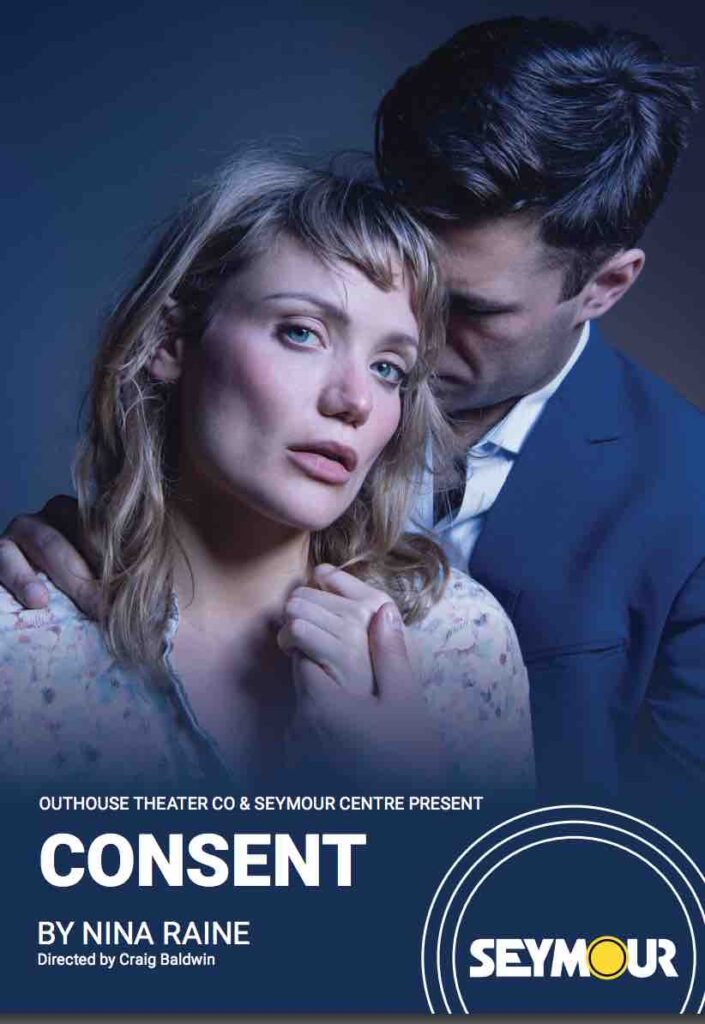
Written by British playwright Nina Raine, Consent examines the subject of rape within a flawed justice system. In the first scenario, a young woman is preyed upon by a known attacker; she’s reluctant to come forward to report him. The lawyers surrounding the case have a field day, using every sleazy tactic in the book to discredit her. The familiar tropes are there If it really was ‘non-consensual’ why didn’t you report it immediately? No machination is spared to cast doubt in the jury’s mind. She texted afterwards ‘she’s fine’. Her mental health makes her less credible. The questions they ask, framed manipulatively, are not about a search for truth or justice, but about winning for the sake of ego, keeping score within and outside the courtroom.
The second scenario in Act 2 involves a married couple in a domestic relationship; the husband who was the sleazy lawyer in scenario 1 now finds himself accused of rape, after coercing his wife for sex when he finds out about her affair with his courtroom rival. Their closest friends who are also lawyers are conflicted on who to side with; was it rape? Or a terrible act of passion in which both parties are equally responsible?

A secondary theme emerges in Act 2: the ‘revenge fuck’ – committing adultery to get back at a cheating partner, to make them suffer, to make them feel actually sorry for what they did. The cold, callous arrogance in Raine’s characters feels inspired Patrick Marber’s Closer, a play notorious for its gritty realism, also set in the UK. In this production, direction by Craig Baldwin assisted by Louisa Panucci creates riveting, powerful theatre as we witness the unravelling of poisoned souls, full of shameful impulses and regret. The actors’ repression and expression of rage gives the story a hard, realistic edge that is at once both recognisable and disturbing. We know exactly what it’s like to ‘be there’ in an argument when we feel as though we’re not being heard, that our needs are not being respected, and we have completely exhausted all sense of rationality and self-control. The flip side is that pure, white hot rage becomes maddeningly labelled as ‘mental instability’. Is it? Or does it depend on the circumstance? The open ended finale sits uncomfortably with the audience.

A challenge in this play is making unlikeable characters redeemable. The cast of seven work well with the meaty script, giving weight to questionable characters who might otherwise come across as privileged and unsympathetic. Anna Samson as Kitty, the doting mother who seems to ‘have everything’ is silently screaming with rage against her husband for his insufferable arrogance and unfaithfulness. Samson creates a wonderful arc that shows the inner turmoil and enormous personal cost of having revenge. Nic English plays Edward, Kitty’s unfaithful husband with a condescending ‘alpha-male’ attitude and manipulating boyish charm. His arc in Act 2 when he becomes a broken man is incredible to watch. Jessica Bell who plays two very different roles (a rape victim and a solicitor) delivers standout performances that completely engages the audience. Anna Skellern plays Zara, a bohemian, lively character who is also crushed by her ‘friends’. Her grief, pallor and onset of depression was very evident and authentic. Sam O’Sullivan is skin-crawling as Tim, another ‘useless’ lawyer who seduces Kitty with feigned integrity and a ‘poor me’ demeanour. Jeremy Waters as Jake, yet another weaselly-worded lawyer / cheating husband is also strong in his role, if thoroughly unlikeable. Jennifer Rani adds balance as Rachel, Jake’s wife and a lawyer; she plays her part well of feeling kicked in the guts by her husband’s cheating, but ultimately, finds a way to reconcile it.

The set (Soham Apte), sound design (Eliza Scott) and lighting design (Ryan McDonald) adds coldness to the drama, making a married couple’s apartment not feel like a warm cozy place full of love, but a dispassionate environment where people are trapped within socially-construed frameworks. The electric blue light in Act 1 contrasts with the warmer amber light in Act 2, when the characters reveal more of their humanity.

There are some nice touches of urban chic such as the tables on inverted jewel green glass vases that had the couple sitting next to me wondering ‘where to get it from’. The two way mirror panelling the entire length of the stage, where the rape victim could look into the scene, is unnerving and very effective in creating tension. Costuming (Soham Apte and Emily Brashaw) is well considered to give the characters an image of privilege and personal style with pops of colour that complements the background.

It’s an interesting choice that Act 2 starts with a visible reset, and not done during the interval while the audience is absent. Witnessing the passage of time is significant; when Edward is sitting on a toddler’s chair sobbing his heart out, burying his tear-streaked face into a stuffed toy, one is forced to witness even the hardest of souls breaking under the volatility of its own corruption.
Consent presented by Outhouse Theater Co & Seymour Centre is playing at Seymour Centre until 24 June 2023. For tickets and showtimes, go to https://www.seymourcentre.com/event/consent/
______________
Images: Phil Erbacher

