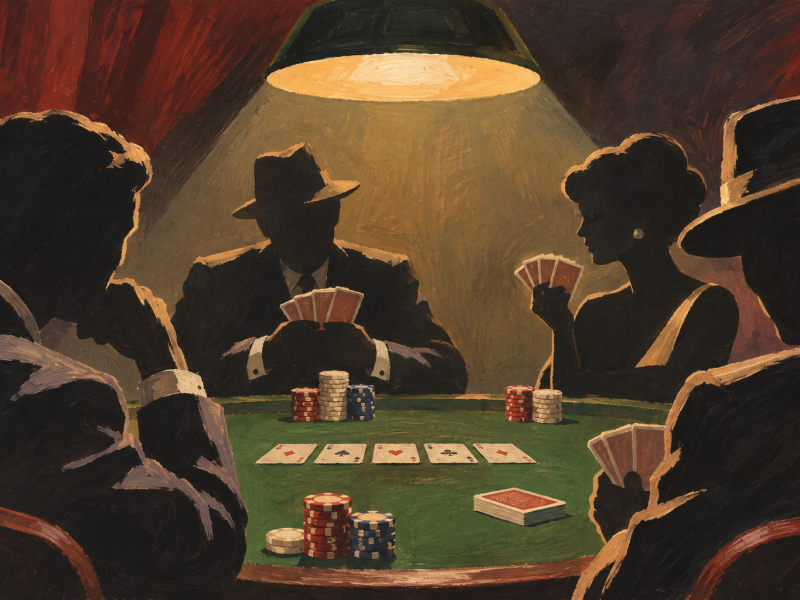

In The Gambler, a professor can explain risk eloquently and still be unable to escape its consequences. Karel Reisz’s 1974 drama puts James Caan’s Axel Freed in a world of debts, bookies and family obligations, where the language of courage becomes entangled with an increasingly costly need to keep betting.
The American Film Institute catalogue credits James Toback with the screenplay and lists Paul Sorvino and Lauren Hutton alongside Caan. Its account of the plot begins with Axel owing $44,000 after a night of gambling. That figure establishes the pressure on him, but the more revealing question is why a way out does not necessarily end the cycle.
Risk as an argument
Axel teaches English literature. The AFI synopsis describes him discussing Dostoyevsky’s ideas about will and desire with a student, and later speaking about writers and risk. Those lectures are not incidental decoration. They place a vocabulary of freedom beside a pattern of behaviour that narrows his choices. The audience is invited to notice the distance between an attractive theory of self-determination and the obligations created by debt.
AFI notes the influence of Dostoyevsky’s 1866 novel The Gambler, while distinguishing the film’s ending from the novel’s. The connection is useful because it points towards a tradition of characters who can explain their own impulses with great sophistication. An explanation, however, is not the same thing as control. That tension makes the film a compelling subject for discussion even for someone approaching it through its documented story rather than a claim to have seen it.
The film’s premise also resists the easy idea that a gambling story must turn on a single decisive win. Money moves through relationships. Axel asks his mother Naomi for help, and his girlfriend Billie must decide how much of his behaviour she can accept. A debt is therefore not simply a number on a ledger: it becomes a demand on the time, trust and resources of other people.
From New York to Las Vegas
According to AFI, the production filmed on location in New York and Las Vegas, including a week of interiors at Caesars Palace. The contrast gives the story two recognisable settings for risk: the ordinary routines of work and family on one hand, and a famous casino environment on the other. The catalogue’s synopsis describes Axel visiting Las Vegas with Billie and winning at roulette and twenty-one before the consequences of his sports bets catch up with him.
That sequence suggests a distinction worth making. A temporary win can alter the amount available to a gambler without resolving the behaviour that produced the original problem. In this story, the question is not just whether Axel can obtain money, but whether he can stop treating another wager as an answer. The film’s interest lies in the logic of that question, rather than in offering gambling as a shortcut to glamour.
A film to revisit thoughtfully
The Museum of the Moving Image included the film in a James Caan retrospective and identified Axel as a college professor whose life echoes Dostoyevsky’s gambler. AFI records a New York opening on 2 October 1974 and a Los Angeles opening one week later. Its catalogue gives running times of 109 or 111 minutes, so a viewer should check the particular edition being offered.
For readers interested in cinema’s treatment of risk, this makes a different companion to a poker contest built around rivalry and reputation. The Gambler turns attention inward, towards rationalisation and the people drawn into a person’s debts. My recommendation rests on that documented dramatic design and its literary context; it is not a claim of a personal viewing or a substitute for encountering the film itself.
Availability is not assessed here. If seeking a screening or legitimate home release, check the current Australian listing and edition directly. The film’s central question remains approachable: when a person calls a dangerous pattern freedom, who pays for that definition?